Please enter the value below for converison from Decagram to Gram units or vice versa.
Table of Contents
Conversion Formula for Decagram to Gram
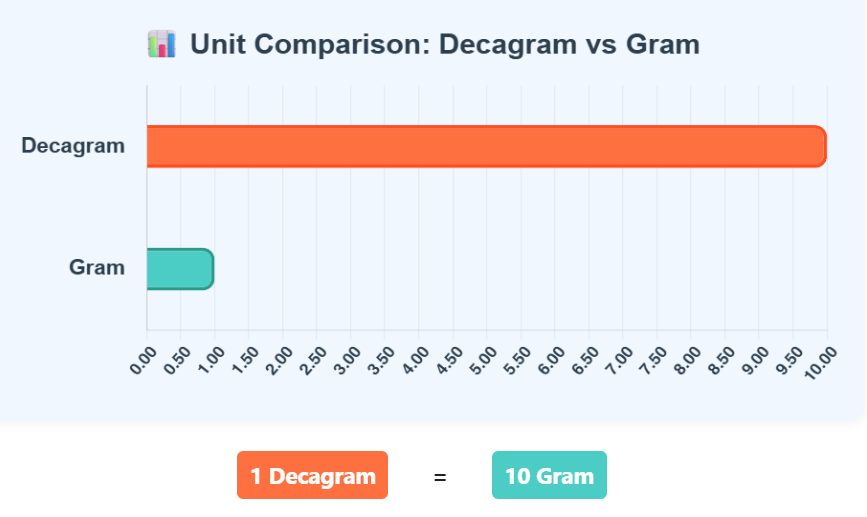
Conversion from decagram to gram is a simple process once you know the basic relationship between the two units. One Decagram is equal to 10 Gram, while one Gram contains 0.1 Decagram.
To change a measurement from decagram to gram, you only need to multiply the number of decagram by 10.
1 Decagram = 10 Gram
1 Gram = 0.1 Decagram
This gives you the equivalent value in gram quickly and accurately. By using this straightforward formula, you can easily switch between these units whenever needed.
Decagram to Gram Conversion
Conversion from decagram to gram unit is an strait forward process once you know the correct conversion factor. One Decagram is equal to 10 Gram, so you can find the value in gram by multiplying the number of decagram by this figure. Example:-
| Decagram | Gram |
|---|---|
| 0.1 Decagram | 1 Gram |
| 1 Decagram | 10 Gram |
| 2 Decagram | 20 Gram |
| 3 Decagram | 30 Gram |
| 5 Decagram | 50 Gram |
| 7 Decagram | 70 Gram |
| 10 Decagram | 100 Gram |
| 20 Decagram | 200 Gram |
| 50 Decagram | 500 Gram |
| 100 Decagram | 1,000 Gram |
Decagram (European Cooking Unit)
Introduction : The decagram is a metric unit equal to ten grams. This might seem small, but it is very popular in Central and Eastern European kitchens. One decagram is about the weight of two teaspoons of sugar or a small egg. Cooks in countries like Hungary, Poland, and the Czech Republic use decagrams every day. Instead of writing ’50 grams of flour’ in a recipe, they write ‘5 decagrams of flour.’ This makes numbers smaller and easier to work with while cooking. The decagram proves that even a less common metric unit can become a favorite in certain places.
History & Origin : The decagram has been part of the metric system since its early days. The prefix ‘deca’ comes from the Greek word for ten, so a decagram is ten grams. While the decagram never became popular in English-speaking countries or Western Europe, it found a strong home in Central and Eastern Europe. These regions had traditional weight units that were close in size to the decagram. As metrication replaced older systems, people simply switched to decagrams because the size felt familiar. The decagram became the standard for home cooking in countries like Hungary, where nearly every household recipe uses it. Today, it remains a living part of these food cultures.
Current Use : The decagram is a star player in the kitchens of Hungary, Poland, Romania, and nearby countries. Cookbooks from these nations list almost all dry ingredients in decagrams, from flour and sugar to rice and oats. A typical recipe might call for 15 decagrams of butter and 25 decagrams of flour. Kitchen scales sold in these countries often include decagram markings. Bakeries sell loaves of bread by the decagram. Even some school lessons teach children to measure in decagrams before grams. Tourists visiting Budapest or Warsaw will see decagrams on food packages and market scales. This unit shows how the same metric system can adapt to local cooking traditions.
Gram (Practical Metric Unit)
Introduction : The gram is a small but very handy metric unit for everyday weight measurements. One gram equals one thousandth of a kilogram, or about the weight of a small paper clip. This size makes it perfect for measuring food portions, cooking ingredients, and small items around the house. While the kilogram works well for heavy things, the gram shines for lighter objects. Nutrition labels show protein, fat, and sugar in grams. Coffee lovers measure their beans in grams for the perfect brew. The gram brings metric measurement down to a human scale.
History & Origin : The gram came to life along with the rest of the metric system in late 1700s France. Originally, scientists defined it as the weight of one cubic centimeter of pure water at its densest temperature. This link between weight and volume was a brilliant idea that made the metric system easy to understand. As the metric system spread across Europe and then the world, the gram became the standard for small weights. Many countries replaced their old small weight units like drams and scruples with the gram. Today, the gram is defined as one thousandth of the official kilogram, keeping it forever linked to the base unit.
Current Use : The gram appears constantly in kitchens, stores, and labs around the world. Cooks use digital scales to measure flour, sugar, and spices in grams for precise baking. Food packages list the weight of chips, cereal, and chocolate bars in grams. Nutrition facts show how many grams of nutrients each serving contains. Pharmacists measure medicine doses in grams or smaller units. Postal scales weigh letters and small packages in grams. Jewelers weigh gold and silver in grams. Scientists use grams for chemical experiments. The gram is the perfect middle ground for measuring things that are too light for kilograms but too heavy for milligrams.
FAQ on Decagram to Gram Conversion:
What are the standard abbreviation or symbols for decagram and gram?
The standard abbreviation for decagram is “dag”, while gram is abbreviated as “g.” These symbols are commonly used to represent units of weight and mass in both everyday contexts and technical measurements.
What is the process of conversion from decagram to gram units?
For conversion from decagram to gram, multiply the number of decagram by 10 as one decagram equals 10 gram.
Formula: No of gram = No of decagram × 10
This is the standard method used for conversion between these units of weight.
How do you convert gram to decagram?
To convert gram to decagram, multiply the number of gram by 0.1 as one gram equals 0.1 decagram.
Formula: No of decagram = No of gram × 0.1
How many decagram are in one gram?
There are 0.1 decagram in one gram.
How many gram are in one decagram?
There are exactly 10 gram in one decagram.
Formula: No of gram = No of decagram × 10
How many gram in 10 decagram?
There are 100 gram in 10 decagram.
Formula: No of gram = No of decagram × 10
Thus, no of gram in 10 decagram = 10 * 10 = 100 gram
How many gram in 100 decagram?
There are 1000 gram in 100 decagram.
Formula: No of gram = No of decagram × 10
Thus, no of gram in 100 decagram = 100 * 10 = 1000 gram