Please enter the value below for converison from Microgram to Milligram units or vice versa.
Table of Contents
Conversion Formula for Microgram to Milligram
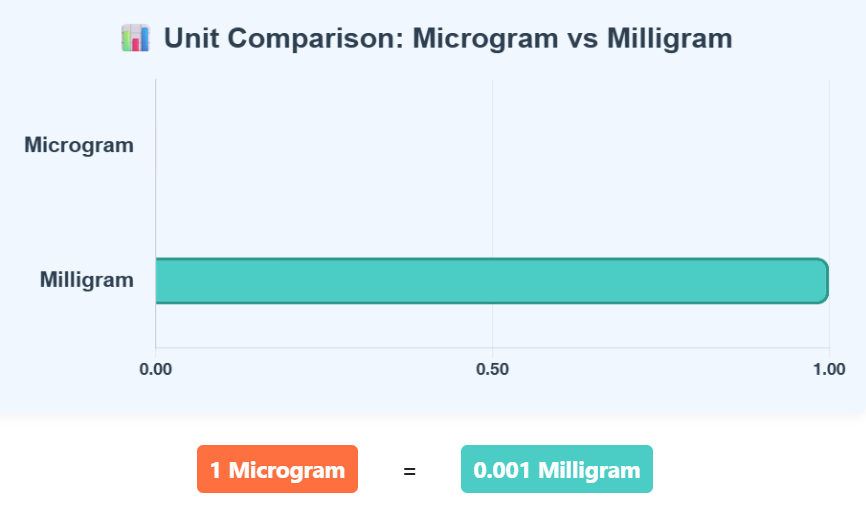
Conversion from microgram to milligram is a simple process once you know the basic relationship between the two units. One Microgram is equal to 0.001 Milligram, while one Milligram contains 1,000 Microgram.
To change a measurement from microgram to milligram, you only need to multiply the number of microgram by 0.001.
1 Microgram = 0.001 Milligram
1 Milligram = 1,000 Microgram
This gives you the equivalent value in milligram quickly and accurately. By using this straightforward formula, you can easily switch between these units whenever needed.
Microgram to Milligram Conversion
Conversion from microgram to milligram unit is an strait forward process once you know the correct conversion factor. One Microgram is equal to 0.001 Milligram, so you can find the value in milligram by multiplying the number of microgram by this figure. Example:-
| Microgram | Milligram |
|---|---|
| 0.1 Microgram | 0.0001 Milligram |
| 1 Microgram | 0.001 Milligram |
| 2 Microgram | 0.002 Milligram |
| 3 Microgram | 0.003 Milligram |
| 5 Microgram | 0.005 Milligram |
| 7 Microgram | 0.007 Milligram |
| 10 Microgram | 0.01 Milligram |
| 20 Microgram | 0.02 Milligram |
| 50 Microgram | 0.05 Milligram |
| 100 Microgram | 0.1 Milligram |
Microgram (Ultra-Small Unit)
Introduction : The microgram is an extremely tiny metric unit for measuring almost invisible amounts. One microgram equals one millionth of a gram, which is incredibly small. A single speck of dust might weigh several micrograms. This unit is vital for very strong medicines, vitamins, and environmental testing. Some drugs work at microgram levels because even a small amount is potent. Vitamin B12 tablets often contain just a few micrograms. Without the microgram, doctors could not give safe doses of powerful medicines. This unit helps us measure things that are far too small for the milligram.
History & Origin : The microgram came into use as science pushed deeper into small measurements. The prefix ‘micro-‘ comes from the Greek word for small. As chemistry and biology advanced in the late 1800s and early 1900s, researchers discovered substances that worked in very tiny amounts. Vitamins, hormones, and some drugs fell into this category. The microgram became the perfect unit for these new discoveries. Some people write it as ‘mcg’ instead of ‘µg’ because the Greek letter µ (mu) can be hard to type or read. Today, the microgram is officially defined from the kilogram through the metric system’s chain of prefixes.
Current Use : The microgram is essential for strong vitamins, potent medicines, and pollution testing. Many vitamin labels show amounts in micrograms, especially for Vitamin B12, Vitamin D, and folate. Some heart medications and hormone pills are measured in micrograms because even a tiny dose is effective. Environmental scientists measure air pollutants like lead or mercury in micrograms per cubic meter. Water quality tests report heavy metals in micrograms per liter. Laboratories use micrograms for DNA samples and other biological materials. Drug testing can detect substances at microgram levels. The microgram allows us to measure and control very powerful substances safely.
Milligram (Small Dose Unit)
Introduction : The milligram is a tiny metric unit that measures very light things. One milligram equals one thousandth of a gram, which is extremely small. To picture this, a single grain of salt weighs about one milligram. This unit is crucial for medicine because many drugs work in very small amounts. A typical headache pill might contain 500 milligrams of medicine. Without milligrams, doctors and pharmacists could not give the right doses. The milligram helps us measure things that are too light for the gram but still matter for health and science.
History & Origin : The milligram grew out of the metric system’s need for smaller units. As science and medicine advanced in the 1800s, researchers needed to measure smaller and smaller amounts of substances. The prefix ‘milli-‘ means one thousandth, so a milligram is simply one thousandth of a gram. This naming system made the metric system easy to learn and use. By the early 1900s, the milligram had become the standard unit for medicine dosing worldwide. Countries that still used old systems like grains and scruples slowly switched to milligrams for clearer and safer medical measurements. Today, the milligram is defined from the kilogram.
Current Use : The milligram is most important for medicine and health products. When you take a pill, the label shows the medicine amount in milligrams, like 200 mg of ibuprofen. Liquid medicines for children give doses in milligrams per milliliter. Vitamins and mineral supplements list their contents in milligrams, such as 500 mg of Vitamin C or 400 mg of calcium. Scientists use milligrams in laboratories for chemical experiments and testing. Environmental reports measure pollutants in milligrams per liter of water. Even coffee packages show caffeine content per serving in milligrams. The milligram helps us handle very small amounts accurately.
FAQ on Microgram to Milligram Conversion:
What are the standard abbreviation or symbols for microgram and milligram?
The standard abbreviation for microgram is “µg (mcg)”, while milligram is abbreviated as “mg.” These symbols are commonly used to represent units of weight and mass in both everyday contexts and technical measurements.
What is the process of conversion from microgram to milligram units?
For conversion from microgram to milligram, multiply the number of microgram by 0.001 as one microgram equals 0.001 milligram.
Formula: No of milligram = No of microgram × 0.001
This is the standard method used for conversion between these units of weight.
How do you convert milligram to microgram?
To convert milligram to microgram, multiply the number of milligram by 1000 as one milligram equals 1000 microgram.
Formula: No of microgram = No of milligram × 1000
How many microgram are in one milligram?
There are 1000 microgram in one milligram.
How many milligram are in one microgram?
There are exactly 0.001 milligram in one microgram.
Formula: No of milligram = No of microgram × 0.001
How many milligram in 10 microgram?
There are 0.01 milligram in 10 microgram.
Formula: No of milligram = No of microgram × 0.001
Thus, no of milligram in 10 microgram = 10 * 0.001 = 0.01 milligram
How many milligram in 100 microgram?
There are 0.1 milligram in 100 microgram.
Formula: No of milligram = No of microgram × 0.001
Thus, no of milligram in 100 microgram = 100 * 0.001 = 0.1 milligram