Please enter the value below for converison from Ounce to Pound units or vice versa.
Table of Contents
Conversion Formula for Ounce to Pound
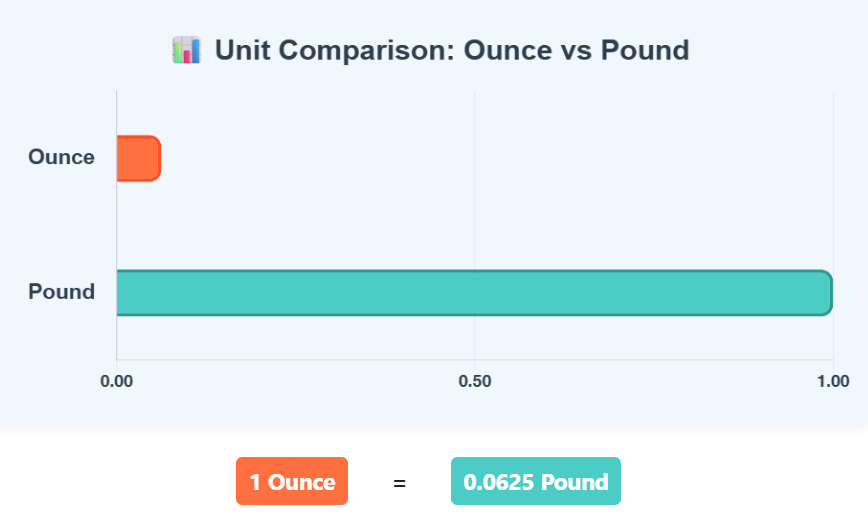
Conversion from ounce to pound is a simple process once you know the basic relationship between the two units. One Ounce is equal to 0.0625 Pound, while one Pound contains 16 Ounce.
To change a measurement from ounce to pound, you only need to multiply the number of ounce by 0.0625.
1 Ounce = 0.0625 Pound
1 Pound = 16 Ounce
This gives you the equivalent value in pound quickly and accurately. By using this straightforward formula, you can easily switch between these units whenever needed.
Ounce to Pound Conversion
Conversion from ounce to pound unit is an strait forward process once you know the correct conversion factor. One Ounce is equal to 0.0625 Pound, so you can find the value in pound by multiplying the number of ounce by this figure. Example:-
| Ounce | Pound |
|---|---|
| 0.1 Ounce | 0.00625 Pound |
| 1 Ounce | 0.0625 Pound |
| 2 Ounce | 0.125 Pound |
| 3 Ounce | 0.1875 Pound |
| 5 Ounce | 0.3125 Pound |
| 7 Ounce | 0.4375 Pound |
| 10 Ounce | 0.625 Pound |
| 20 Ounce | 1.25 Pound |
| 50 Ounce | 3.125 Pound |
| 100 Ounce | 6.25 Pound |
Ounce (Small US Weight Unit)
Introduction : The ounce is a smaller unit of weight commonly used in the United States. There are 16 ounces in one pound, making it perfect for measuring lighter items. You often see ounces on food packages, drink cans, and cooking ingredients. This unit helps people measure things that would be too small for pounds but too large for grams. For example, a slice of bread or a serving of cheese is measured in ounces. Ounce measurements appear on nutrition labels, postal scales, and kitchen tools across America.
History & Origin : The name ‘ounce’ comes from the Latin word ‘uncia,’ which meant one-twelfth of something. The ancient Romans used this term for both weight and length. Over many centuries, different systems of measurement used the ounce, including the troy system for precious metals and the avoirdupois system for everyday goods. The avoirdupois ounce became the standard for general use in England and later in America. In the 1950s and 1960s, English-speaking countries agreed to define the ounce exactly as 28.349523125 grams. This agreement helped trade and science work more smoothly across borders.
Current Use : The ounce is very useful for measuring small everyday items in the United States. Cooking and baking recipes often call for ounces of ingredients like butter, chocolate, or nuts. Postal scales show the weight of letters and small packages in ounces. Beverage cans list their contents in fluid ounces, though that measures volume, not weight. Jewelry stores sometimes weigh gold and silver in ounces. Food nutrition labels show serving sizes in ounces for products like cereal, chips, and frozen meals. The ounce helps people handle amounts that are too small for pound measurements.
Pound (Standard US Weight Unit)
Introduction : The pound is the main unit for measuring weight in the United States. People use it every day for things like body weight, food packages, and exercise equipment. One pound is equal to 16 ounces. While most of the world uses kilograms, the United States has kept the pound as its standard for daily life. This unit is deeply rooted in American culture, from grocery shopping to gym workouts. You will see pounds on food labels, bathroom scales, and postal packages across the country.
History & Origin : The pound has a very long history that goes back to ancient Rome. The Romans used a unit called the ‘libra,’ which is why the symbol for pound is ‘lb.’ Over time, different countries used different versions of the pound. In the 1800s, England created the avoirdupois pound, which became the standard. When the British Empire spread, so did this pound. The United States kept using this same definition even after it became independent. Today, the pound is officially defined as exactly 0.45359237 kilograms, linking it to the metric system while keeping its traditional use.
Current Use : People in the United States use pounds for almost all daily weight tasks. When someone steps on a bathroom scale, it shows their body weight in pounds. Grocery stores sell fruits, vegetables, and meat by the pound. Fitness centers have weights marked in pounds for strength training. Postal services charge based on package weight in pounds. Recipes in American cookbooks list ingredients like flour and sugar in pounds. Even industries like shipping and construction use pounds for measurements. The pound remains the go-to unit for anyone living in the US.
FAQ on Ounce to Pound Conversion:
What are the standard abbreviation or symbols for ounce and pound?
The standard abbreviation for ounce is “oz”, while pound is abbreviated as “lb.” These symbols are commonly used to represent units of weight and mass in both everyday contexts and technical measurements.
What is the process of conversion from ounce to pound units?
For conversion from ounce to pound, multiply the number of ounce by 0.0625 as one ounce equals 0.0625 pound.
Formula: No of pound = No of ounce × 0.0625
This is the standard method used for conversion between these units of weight and mass.
How do you convert pound to ounce?
To convert pound to ounce, multiply the number of pound by 16 as one pound equals 16 ounce.
Formula: No of ounce = No of pound × 16
How many ounce are in one pound?
There are 16 ounce in one pound.
How many pound are in one ounce?
There are exactly 0.0625 pound in one ounce.
Formula: No of pound = No of ounce × 0.0625
How many pound in 10 ounce?
There are 0.625 pound in 10 ounce.
Formula: No of pound = No of ounce × 0.0625
Thus, no of pound in 10 ounce = 10 * 0.0625 = 0.625 pound
How many pound in 100 ounce?
There are 6.25 pound in 100 ounce.
Formula: No of pound = No of ounce × 0.0625
Thus, no of pound in 100 ounce = 100 * 0.0625 = 6.25 pound