
Please enter the value below for converison from Tonne to Kilogram units or vice versa.
Table of Contents
Conversion Formula for Tonne to Kilogram
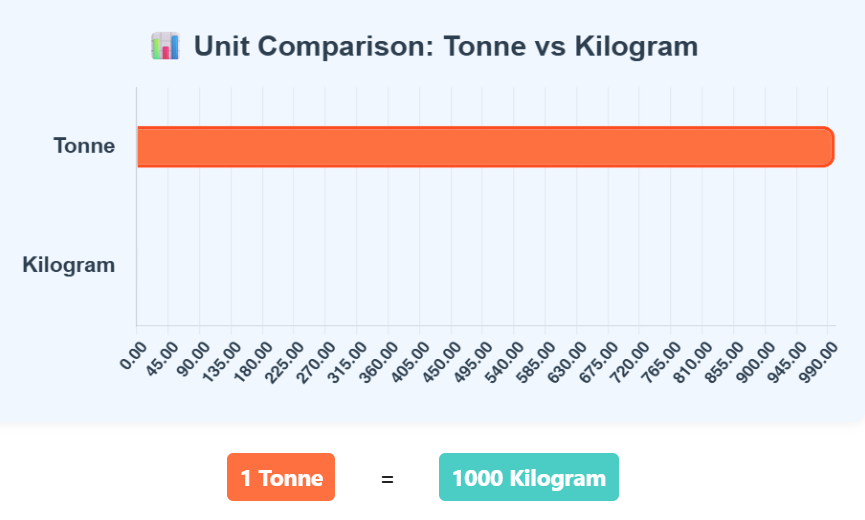
Conversion from tonne to kilogram is a simple process once you know the basic relationship between the two units. One Tonne is equal to 1,000 Kilogram, while one Kilogram contains 0.001 Tonne.
To change a measurement from tonne to kilogram, you only need to multiply the number of tonne by 1,000.
1 Tonne = 1,000 Kilogram
1 Kilogram = 0.001 Tonne
This gives you the equivalent value in kilogram quickly and accurately. By using this straightforward formula, you can easily switch between these units whenever needed.
Tonne to Kilogram Conversion
Conversion from tonne to kilogram unit is an strait forward process once you know the correct conversion factor. One Tonne is equal to 1,000 Kilogram, so you can find the value in kilogram by multiplying the number of tonne by this figure. Example:-
| Tonne | Kilogram |
|---|---|
| 0.1 Tonne | 100 Kilogram |
| 1 Tonne | 1,000 Kilogram |
| 2 Tonne | 2,000 Kilogram |
| 3 Tonne | 3,000 Kilogram |
| 5 Tonne | 5,000 Kilogram |
| 7 Tonne | 7,000 Kilogram |
| 10 Tonne | 10,000 Kilogram |
| 20 Tonne | 20,000 Kilogram |
| 50 Tonne | 50,000 Kilogram |
| 100 Tonne | 100,000 Kilogram |
Tonne (Large Metric Unit)
Introduction : The tonne, also called the metric ton, is a large metric unit for very heavy things. One tonne equals 1,000 kilograms, which is about the weight of a small car. This unit is not for everyday use in homes or stores. Instead, it shines in industry, shipping, farming, and construction. When people talk about how much a truck can carry or how much grain a farm produces, they use tonnes. The tonne helps us talk about big weights without using huge numbers of kilograms. It makes heavy measurements simpler and clearer for everyone involved in big work.
History & Origin : The tonne was created when people needed a larger unit than the kilogram for heavy goods. As global trade grew in the 1800s and 1900s, ships carried cargo weighing thousands of kilograms. Saying a ship carried 10,000 kilograms was fine, but saying 10 tonnes was easier. The name ‘tonne’ comes from the same old word as ‘tun,’ which meant a large wine barrel. This was different from the imperial ton used in England and America, which weighed 2,240 pounds or 2,000 pounds. To avoid confusion, metric countries used ‘tonne’ and the symbol ‘t’ for exactly 1,000 kilograms. Today, the tonne is the worldwide standard for heavy measurements.
Current Use : The tonne is the go-to unit for heavy industry and large-scale trade around the world. Shipping companies measure cargo weight in tonnes for containers, trucks, and trains. Farmers talk about wheat, corn, or rice harvests in tonnes per hectare. Mining companies report how much ore or coal they dig up in tonnes. Construction crews order concrete, steel, and gravel by the tonne. Car makers list vehicle weights in tonnes. Recycling centers measure scrap metal and paper in tonnes. Airplanes have maximum takeoff weights in tonnes. Environmental reports track carbon emissions in millions of tonnes. The tonne makes big numbers manageable and clear for heavy work.
Kilogram (Base Unit of Mass)
Introduction : The kilogram is the main building block for measuring weight in the metric system. Nearly every country in the world uses it for daily tasks like buying food, weighing people, and shipping packages. One kilogram equals one thousand grams. This unit sits at the heart of science, trade, and normal life across the globe. From market stalls selling vegetables to laboratories doing experiments, the kilogram is the trusted standard. It replaced many old and different weight systems, bringing everyone onto the same page for fair and clear measurements.
History & Origin : The kilogram was born during the French Revolution around 1795. The new French government wanted a measurement system based on nature, not random kings or local customs. They defined the kilogram as the weight of one liter of pure water. Later, they made a metal cylinder called the International Prototype Kilogram to serve as the official standard. This cylinder sat in a vault near Paris for over one hundred years. In 2019, science advanced enough to redefine the kilogram using Planck’s constant, a fixed number from physics. This change made the kilogram even more stable and accurate for all time.
Current Use : People use kilograms everywhere in daily life across metric-using countries. When you go to a grocery store, fruits, vegetables, and meat are priced per kilogram. Your bathroom scale likely shows your body weight in kilograms. Luggage limits at airports are given in kilograms. Fitness centers use kilogram plates for weight training. Postal services charge based on kilogram weight. Recipes from most countries list ingredients in kilograms or grams. Even industries like shipping, farming, and manufacturing rely on kilograms for accurate measurements. The kilogram truly is the people’s weight unit.
FAQ on Tonne to Kilogram Conversion:
What are the standard abbreviation or symbols for tonne and kilogram?
The standard abbreviation for tonne is “t”, while kilogram is abbreviated as “kg.” These symbols are commonly used to represent units of weight and mass in both everyday contexts and technical measurements.
What is the process of conversion from tonne to kilogram units?
For conversion from tonne to kilogram, multiply the number of tonne by 1000 as one tonne equals 1000 kilogram.
Formula: No of kilogram = No of tonne × 1000
This is the standard method used for conversion between these units of weight.
How do you convert kilogram to tonne?
To convert kilogram to tonne, multiply the number of kilogram by 0.001 as one kilogram equals 0.001 tonne.
Formula: No of tonne = No of kilogram × 0.001
How many tonne are in one kilogram?
There are 0.001 tonne in one kilogram.
How many kilogram are in one tonne?
There are exactly 1000 kilogram in one tonne.
Formula: No of kilogram = No of tonne × 1000
How many kilogram in 10 tonne?
There are 10000 kilogram in 10 tonne.
Formula: No of kilogram = No of tonne × 1000
Thus, no of kilogram in 10 tonne = 10 * 1000 = 10000 kilogram
How many kilogram in 100 tonne?
There are 100000 kilogram in 100 tonne.
Formula: No of kilogram = No of tonne × 1000
Thus, no of kilogram in 100 tonne = 100 * 1000 = 100000 kilogram